
Everything Waits for the Partner: How to Fix the Review Bottleneck in a Small Accounting Firm
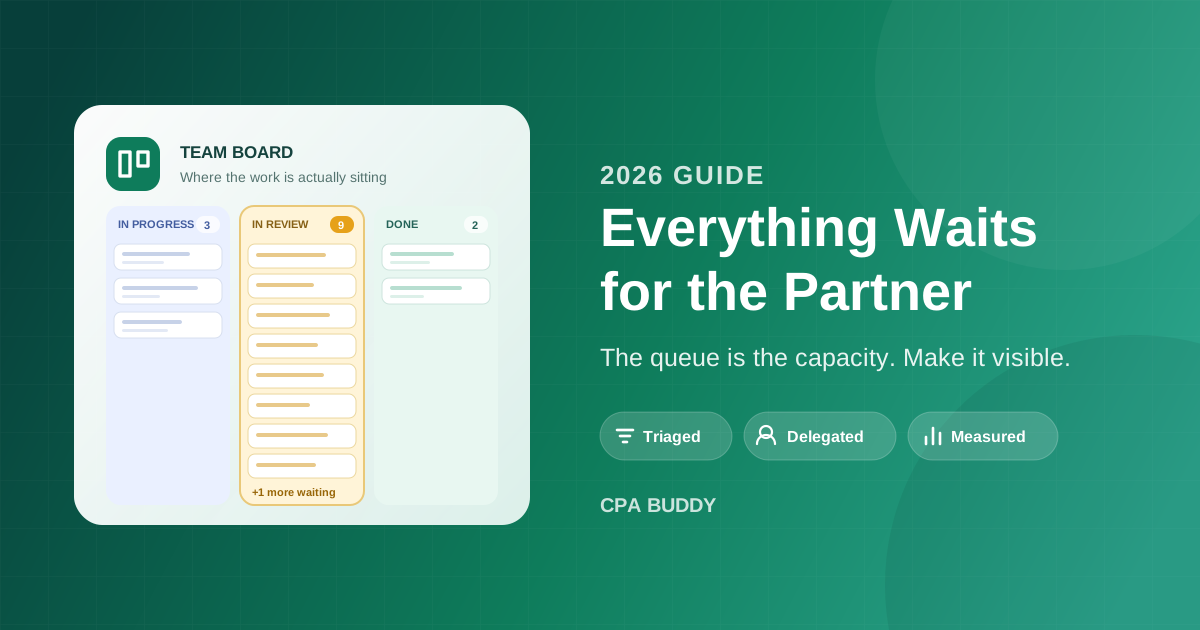
It is the third week of April and the board looks productive. Nine files are finished. All nine are sitting in review, and the person who reviews them has four client meetings and a T2 of his own. The preparers are not idle, because idle feels wrong, so they have started the next batch of returns. Those will also be finished, and they will also sit. By the end of the month the firm has done an enormous amount of work and delivered very little of it. Nobody is slacking and nothing is broken. The firm simply has one reviewer, and a queue in front of him that grows a little every day.
- A review queue is a capacity ceiling. Adding a preparer to a firm with one reviewer makes the queue longer, not the output larger.
- Much of what happens in review is not review. Formatting, chasing missing documents, and answering questions the preparer could have decided all belong upstream.
- Review has to be a tracked state with a named owner, or nobody can see how long work has been waiting.
- For Canadian firms performing compilations and other related services engagements, review is a documented obligation under CSQM 1, not only a workflow preference.
The Queue Is Your Firm’s Real Capacity
Work through the arithmetic once and the problem stops feeling like a personality issue. If the team finishes six files a day and the reviewer clears four, the queue grows by two every day. Over a ten week season that is one hundred files that exist, are paid for in staff hours, and have not gone anywhere. No amount of goodwill changes the two.
This is why hiring another preparer so often fails to fix anything. It raises the rate at which work arrives at the constraint. The queue gets longer and the reviewer, who was already the busiest person in the building, now has more to answer for. A firm with one reviewer has one reviewer’s worth of throughput no matter how many people it employs.
The second cost is less visible. Work that cannot be delivered cannot be billed, so a review queue converts directly into the unbilled work and slow invoicing that shows up in the firm’s cash position two months later. Everything is 90 percent done. Ninety percent done is worth nothing.
Most Review Time Is Not Review
Sit with a partner for an afternoon of review and watch what the time actually goes on. Very little of it is professional judgment.
Presentation and formatting
Rounding, note wording, a schedule laid out differently than the firm does it. Real corrections, but corrections a checklist catches for free.
Information that never arrived
The reviewer opens the file, finds a missing slip, and becomes the person chasing the client. The preparer moved on three days ago.
Questions with obvious answers
A treatment the preparer could have decided, or looked up, but flagged instead because flagging is safer than being wrong.
None of that requires a partner. All of it consumes partner hours at the exact moment those hours are scarcest. The single highest-return change available to most small firms is not a better reviewer or a faster one. It is a written definition of what a file must look like before it is allowed into the queue.
Keep it short enough to actually use. A file is ready when every requested document is in the file or explicitly noted as unavailable, the preparer has recorded a conclusion on every open question rather than a question, prior year comparatives tie, the firm’s presentation standards are met, and the preparer has stated in one line what they want the reviewer to focus on. Files that fail the definition go back before the reviewer opens them, not after.
That last item is worth its own sentence. A preparer who has to name what the reviewer should look at has to think about the file as a whole, which is a different mental act from completing it. It is also the fastest way to shorten a review, because the reviewer starts where the risk is instead of hunting for it.
Review Is a State, Not an Inbox
In most small firms, review begins when a preparer sends a message. From that moment the status of the work lives in one person’s inbox and in their memory of what they have and have not looked at. Nobody else can see the queue. Nobody can tell you how long the oldest file has been waiting, because the information does not exist anywhere.
Making review a tracked status changes what is possible. A file moves from In Progress to In Review with a named reviewer attached, and it moves out when that reviewer approves it or sends it back for rework. Now the queue is a column somebody can look at, its age is measurable, and a preparer can see that their file is third in line rather than assuming it was forgotten.
The practical version of this is a task and review workflow where completed work routes to a designated reviewer, the reviewer approves or requests rework, and the whole exchange stays attached to the task instead of scattering across email. Engagements carry the same status path, with a state history that records how the work progressed. That history matters more than it sounds, and the next section explains why.
Ask your firm how many days the average file spends in review. Almost nobody can answer, and it is the single most useful number for diagnosing capacity. If files wait four days for a review that takes forty minutes, the problem is not the reviewer’s speed. It is that the queue has no visibility and no priority order.
Not Every File Needs the Partner
The instinct to review everything personally is not vanity. It is usually a partner who has been burned once and decided never again. The problem is that applying the same standard to a fifteen year client whose return has not changed and to a brand new corporate file spends the scarcest resource in the firm on the work that needs it least.
Risk-based triage costs nothing and frees a surprising amount of time.
Routine recurring work
Long-standing clients, no change in circumstances, figures in line with prior year.
The preparer, against the firm's checklist, with a senior signing off.
A sample after filing rather than every file before it.
Standard files
Normal complexity, established clients, nothing unusual in the year.
A manager or senior reviewer.
Exceptions the reviewer escalates, and the rework reasons each month.
Judgment files
New clients, first-year files, changed structure, unusual transactions, anything the preparer flagged.
The partner, in full.
Everything. This is what partner review is for.
Engagements meeting the firm's EQR policy
Work where the firm's own quality management policies require an engagement quality review.
A reviewer who meets the eligibility and objectivity requirements of CSQM 2.
The documented review, retained on the file.
Write the triage rules down and apply them at the point a file is created, not when it lands in the queue. An engagement that already knows which tier it belongs to routes itself.
What Canadian Standards Actually Require
There is a version of this conversation that treats review as an efficiency preference. For Canadian firms it is more than that, and the detail many small practices missed is a matter of scope.
CSQM 1 and CSQM 2 replaced CSQC 1, and the new standards reach further. CSQC 1 applied to assurance engagements. The CSQMs apply to firms performing audits, reviews of financial statements, other assurance engagements, and related services engagements, which brings compilations under CSRS 4200 into scope. Systems of quality management for assurance work had to be designed and implemented by December 15, 2022, and for related services engagements by December 15, 2023, with the first evaluation performed within one year of the applicable date and evaluations continuing at least annually.
The part that bears directly on a review bottleneck is the shape of CSQM 1. It is risk-based. A firm identifies its quality objectives, identifies the risks to meeting them, and designs responses. A practice whose entire review capacity is one person, during the ten weeks of the year when that person is least available, has a quality risk on its hands whether or not anyone has written it on a form. Documenting the response is the requirement. Actually having a second reviewer, a checklist, and a queue somebody can see is the response.
CSQM 2 then governs engagement quality reviews specifically: who may be appointed, the eligibility and objectivity that person needs, and how the review is performed and documented. For a sole practitioner this is where the arithmetic gets uncomfortable, because you cannot objectively review your own work, which is why external reviewer arrangements exist between small firms.
These standards apply to firms performing assurance or related services engagements. A practice that does only tax preparation and bookkeeping is in a different position from one that issues compilations, and the requirements that apply to your firm depend on the engagements you actually perform. Treat this as a reason to check with your provincial body or practice advisor, not as a substitute for doing so.
Making the Second Reviewer Real
Delegating review is not an announcement at a Monday meeting. It fails when a partner says the manager will review the simple ones, then quietly re-reviews them anyway, which teaches everyone that the first review was theatre. A handover that survives contact with tax season looks like this.
Pick the narrowest slice first
One file type, the most routine one you have. Recurring returns for clients whose circumstances have not changed. Resist the urge to hand over a category with interesting exceptions in it.
Extract what the review actually checks
Sit with the partner and write down what they look at and in what order. Most of it has never been said out loud. This list becomes the reviewer's checklist and, conveniently, the preparer's.
Review in parallel for one cycle
Both people review the same files independently, then compare. The differences are the real training material, and there are always fewer of them than the partner expects.
Flip the default
The manager becomes the reviewer of record for that slice. The partner sees escalations, not files. This is the step firms skip, and skipping it means nothing changed.
Sample instead of gatekeeping
Pull a handful of completed files each month and review them after the fact. You keep the assurance without keeping the queue.
Roles should reflect the change. A senior preparer who now reviews needs visibility across the team without full administrative control of the firm, which is what a manager role is for. Assign preparers, reviewers, and the partner to the same engagement record so responsibility is explicit rather than implied by who happens to reply.
Writing the review standard down is the same exercise as documenting the firm before a first hire. In both cases the constraint is not the work. It is that the method lives in one person’s head, and a method in one person’s head cannot be delegated, audited, or improved.
The Numbers That Tell You It Is Working
Five measures cover it, and none of them require a new tool if the work already carries a status and an owner.
- Average and worst-case days a file spends in a review state.
- The size of the review queue on any given day, next to how many files the team completes per day. If the first number is growing, review is your constraint.
- Rework rate, and more usefully the reasons. A pattern in the reasons is a missing line on the ready-for-review checklist.
- The share of files reviewed by someone other than the partner. This is the delegation measure, and it should move every quarter.
- Staff utilization during the queue’s worst week. Preparers who were busy while finished work sat still were busy on the wrong thing.
Engagement pipeline, blocked and stale work, and staff hours and utilization all sit in reports and analytics, which is the reporting side of running the firm on visibility rather than status meetings. The point of the numbers is not the dashboard. It is that a bottleneck nobody measures gets explained away as a busy season every single year.
A Review Readiness Checklist
Before your next filing season, confirm that:
- The firm has a written definition of what makes a file ready for review.
- Review is a distinct status with a named reviewer, not a message in someone’s inbox.
- Somebody can state the average number of days a file waits in review.
- Files are triaged by risk when the engagement is created, not when it reaches the queue.
- At least one file type is reviewed by someone other than the partner, as the default rather than the exception.
- Rework reasons are recorded and read monthly.
- Your quality management obligations reflect the engagements the firm actually performs, and the review arrangements behind them are documented.
- The partner’s sample review of delegated work is scheduled, not improvised.
A review bottleneck is rarely a competence problem and almost never a motivation problem. It is a queue in front of the one person nobody has been willing to take work away from, and it holds the firm at that person’s capacity no matter how many people are hired. Start with the two cheapest moves. Write down what ready for review means, and make review a status with an owner so the queue becomes something you can see. Then hand one narrow slice of files to a second reviewer and leave it handed over. CPA Buddy gives every task and engagement an owner, a review state, and a history, so you can see what is waiting, how long it has waited, and who it is waiting on.
Frequently Asked Questions
What is a review bottleneck in an accounting firm?
It is the point where finished work accumulates because only one person can approve it. Preparers complete files faster than the reviewer can clear them, so the queue grows every day of the busy period. The firm's real capacity stops being the number of preparers and becomes the number of hours the reviewer has available.
How can a small firm reduce the time work spends in partner review?
Start by removing the work that is not review. Define in writing what a file must satisfy before it can enter the review queue, covering completeness, formatting, resolved questions, and supporting documents. Files that arrive already meeting that standard take a fraction of the time. After that, move routine recurring work to a second reviewer and keep the partner for new clients, first-year files, and anything that changed.
Should every tax return get a partner review?
Not usually. Risk-based triage serves most firms better than a single standard applied to everything. A recurring return for a long-standing client with no change in circumstances does not need the same attention as a first-year file or a client whose structure changed. Reserve partner time for the files where judgment actually matters, and sample the routine work after the fact instead of before.
Do Canadian quality management standards apply to firms that only perform compilations?
Yes, and this is the change many small firms missed. CSQM 1 and CSQM 2 replaced CSQC 1 and extended quality management to related services engagements, which include compilations under CSRS 4200, rather than assurance engagements alone. Systems for related services engagements had to be designed and implemented by December 15, 2023, with an evaluation performed within one year and at least annually thereafter. Confirm the specifics with your provincial body, since the scope depends on the engagements your firm actually performs.
How do you measure whether review is the constraint in your firm?
Track the number of days a file sits in a review status, and compare the size of the review queue with how many files the team completes each day. If the queue grows through the season while preparers start new work to stay busy, review is the constraint. Rework rate is the companion measure, because a high proportion of files sent back usually means the problem is what enters review rather than who performs it.
Related Articles
7 Accounting Workflows You Should Automate First (With Templates) — 2026 Guide
7 min read
WorkflowsCollect Tax Documents from Clients Without the Email Chase: A 2026 Playbook
7 min read
WorkflowsStop Cloning Your Tax Workflow: When One Template With Branches Beats Five Copies
12 min read
Ready to streamline your practice?
Join accounting firms across North America using CPA Buddy to transform their practice management.