
Unbilled Time and Overdue Invoices: How Accounting Firms Track What They're Actually Owed
The partner runs the numbers in August and something does not reconcile. The firm was busier this year than last. Everyone worked more hours. Revenue is flat. No client refused to pay and nothing went to collections, so where did the work go? Three places, usually. Hours that were never written down, engagements that finished in April and were invoiced in June, and invoices that went out and were never looked at again. Only the last one looks like a problem, which is exactly why the first two are normally bigger. This guide is about seeing all three, because getting paid for the work you do depends far more on the first two than most firms expect.
- Revenue leaks in three places, and only the last one looks like a collections problem: time nobody logged, work nobody invoiced, and invoices nobody watched.
- Unbilled work in progress is no longer invisible at year end, so weak time records now create a tax problem as well as a billing one.
- Issuing an invoice late does not push the GST/HST into a later reporting period when the delay is undue. It only delays the cash.
- An A/R aging report read weekly is a report card on your own billing habits before it is a list of slow-paying clients.
Three Leaks, and Only One of Them Looks Like a Problem
Ask a firm owner where money is going and the answer is almost always the clients who pay late. That is the leak with a number attached to it, so it gets the attention. The two upstream of it have no number at all, which is why they grow quietly.
The hour nobody wrote down
A twelve-minute call, a question answered between two other files, a review that ran long. None of it reached a timesheet, so none of it can reach an invoice.
The work that finished before the invoice
The return was filed in April. The invoice went out in June. Two months of the firm’s own cash, given away by nobody in particular.
The invoice nobody looked at again
It was issued, emailed, and then left alone. The client is not refusing to pay. Nobody has mentioned it since April.
The first two leaks share a property that makes them dangerous. Nothing tells you they happened. A client who pays 90 days late produces a report line, a nagging feeling, and eventually a phone call. An hour that was never recorded produces silence.
The Hour Nobody Wrote Down
Time reconstructed from memory is always wrong in the same direction. It rounds down, and it rounds down hardest on the work that was interrupted, which is usually the work that took the most out of you. Friday afternoon timesheets do not capture the Tuesday call about a client’s instalment notice, or the forty minutes spent on a review that was budgeted at fifteen.
Start-and-stop timers are the usual proposed fix, and they suit accounting work badly. The work is interrupt-driven by nature. Nobody stops a timer on the corporate file to answer a question about a different client’s payroll remittance, then restarts it, then stops it again for the phone. A weekly grid, where each row is an engagement and task pair and each column is a day, fits the way the work actually goes. Staff fill in cells at the end of each day rather than reconstructing a week.
Two habits do most of the work here. Enter hours at the end of the day rather than the end of the week, and require every entry to name an engagement and a task rather than a client alone. The second habit is what makes the data usable later, because time that is not attached to an engagement cannot be pulled onto that engagement’s invoice.
Approval matters as much as capture. Hours that go straight from a staff member’s head onto an invoice carry whatever errors were in them. A submit-and-approve cycle each week gives a manager one pass to catch the entry logged against the wrong client before it reaches a budget, a report, or a bill. That is the argument for connecting timesheets and billing rather than running time in one place and invoices in another.
Unbilled Work Is No Longer Invisible at Year End
For most of the profession’s history, section 34 of the Income Tax Act let designated professionals elect to leave year-end work in progress out of income until it was billed. That election was repealed for taxation years beginning after March 21, 2017, and the five-year phase-in has now run its course. Paragraph 10(5)(a) puts professional work in progress into inventory. Subsection 10(1) values it at the lower of cost and fair market value, with a fair market value option under regulation 1801.
The consequence for a small firm is easy to miss, and it has nothing to do with billing. Your unbilled work is now a number you have to produce at year end, and the quality of that number depends entirely on records your staff kept during the year. A firm that logs time against engagements can value work in progress from its own data. A firm that does not is estimating, and an estimate is a poor thing to defend.
The most common reason small firms skip time tracking is that they bill fixed fees, so hours feel irrelevant to the invoice. Year-end work in progress does not care how you price. If work has been performed and not billed, the firm is carrying it, and someone has to put a value on it. Valuation involves judgment, so confirm the approach that fits your own year end.
Invoice Lag Is the Gap You Control Completely
Of the three leaks, this one is entirely inside your firm. No client causes it and no client can fix it. Measure a single number: the days between the last piece of work on an engagement and the date on the invoice.
Long gaps cost you twice. Cash arrives later, which is the obvious half. The less obvious half is that the perceived value of the work decays. An invoice that lands the week a return is filed reads as the natural end of a job the client remembers. The same invoice in July reads as a bill that arrived out of nowhere, and it draws questions about the amount that nobody would have asked in April.
Under subsection 168(1) of the Excise Tax Act, tax is payable on the earlier of the day consideration is paid and the day it becomes due. Subsection 152(1) then deems consideration due on the earliest of the day you first issue the invoice, the date on the invoice, the day you would have issued it but for an undue delay, and the day the client is required to pay under a written agreement. Late invoicing delays your cash. It does not reliably move the GST/HST into a later reporting period.
The fix is structural rather than motivational. Nobody needs to be reminded to bill more promptly. The billing step needs to exist in the workflow, with an owner and a due date, the way the filing step already does.
Make invoicing part of finishing
An engagement is not complete when the return is filed. It is complete when the invoice is issued. Give that step an owner and a date inside the workflow instead of leaving it to month end.
Bill long engagements in stages
Anything running past a month should invoice at agreed points, so neither side meets a single large number months after the work started. Set those points before the work begins, not after.
Review unbilled time before issuing
Open the engagement, look at what is unbilled, and decide what goes on the invoice. Writing time off is a decision worth making deliberately. Forgetting it is not a decision at all.
Issue with terms already agreed
Due on receipt, net 15, net 30. Payment terms belong in the engagement letter and on the invoice, not in an awkward conversation after the client questions the due date.
Record settlement when it arrives
An invoice that was paid last week and still shows as outstanding makes every report downstream of it wrong, including the one you use to decide who to call.
Tracking budget against actual on the engagement record is what turns this into a habit with feedback. You see which engagements ran over before the invoice goes out, not a year later when you are setting next season’s fee.
What an A/R Aging Report Actually Tells You
Most firms read an aging report as a list of who owes what. Read the other way, from your side of the relationship, it describes your own process. Each bucket has a different meaning and a different owner.
1 to 30 days
Normal payment float. Nothing has gone wrong.
That the invoice actually reached the client and was opened, rather than sitting in a filtered mailbox.
Nobody. Leave it alone.
31 to 60 days
Usually your process rather than the client. Terms were never agreed, or the invoice arrived long after the work.
The gap between the last work date and the invoice date on that engagement.
Whoever owns the billing step.
61 to 90 days
A question the client has not asked out loud, often about scope or an amount they did not expect.
Whether the engagement letter covered what was billed.
The relationship owner, by phone rather than email.
90 days and beyond
A decision rather than a receivable. Something has to change.
Whether the firm is still doing work for this client while the balance sits.
A partner.
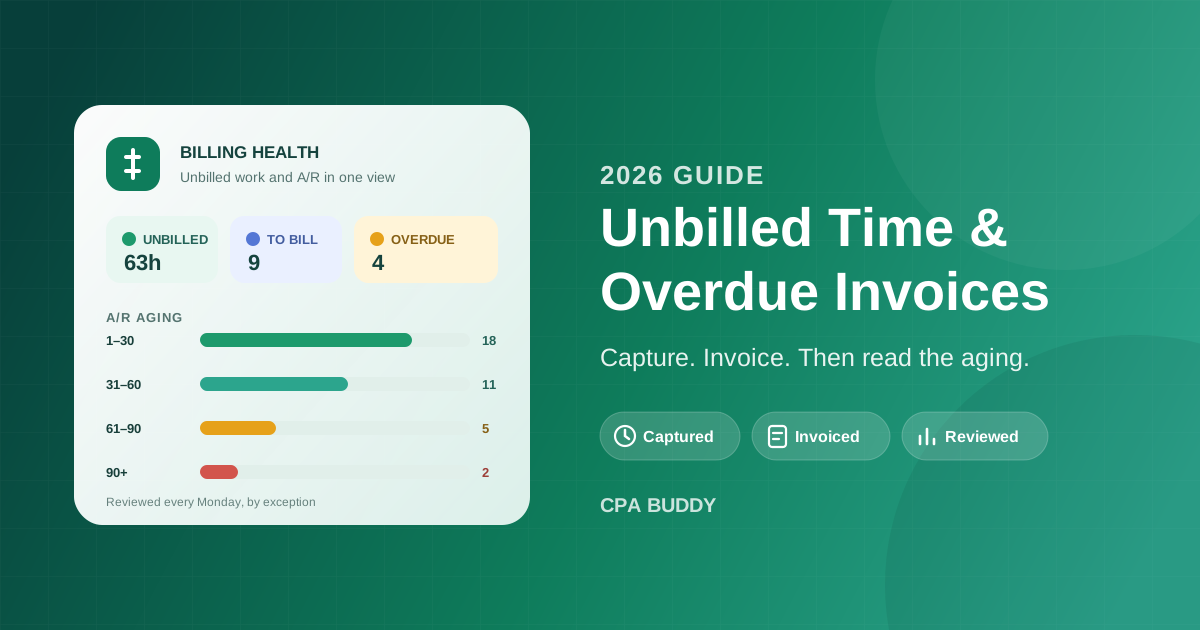
The shape across the buckets tells you more than any single balance. If most of your outstanding value sits in the 31 to 60 range, you do not have difficult clients. You have a billing cadence that taught them what your due dates are worth. That is a much easier thing to fix, and it is the reason the aging report belongs in your own reports and analytics rather than in a bookkeeper’s month-end file.
The Weekly Billing Review
Fifteen minutes on a fixed day, run by exception. The point is not to review every client. It is to catch the handful of items that are still cheap to correct. Five questions cover it:
- Which engagements are carrying unbilled time more than 30 days old?
- Which engagements are finished but have no invoice?
- Which invoices moved into a worse bucket this week?
- Which active clients have no open engagement, leaving staff with nowhere to log time?
- Which invoices were paid but never recorded as settled?
A firm already running a weekly deadline review can add these to the same meeting. The two reviews answer the same underlying question a week apart: what is quietly stuck.
Tax the way your province labels it
One configurable rate with your own label, per-line taxable toggles, and tax-exempt invoices when they apply.
Set the firm defaults once
Currency, payment terms, payment instructions, numbering prefixes, and footer text configured at the firm level and reused on every invoice.
Canadian data residency
Client records, invoices, and receipts stay in Canada, with a firm-wide audit trail and role-based access.
Most Billing Problems Started in the Engagement Letter
A surprising share of aged receivables trace back to something that was never written down. The client did not agree to net 30 because nobody named a payment term. The scope grew through four small favours, so the invoice covered work the client does not remember requesting. Neither problem is solvable at the point of collection, and both are cheap to prevent at the point of engagement, which is what engagement letters are for.
The same logic applies to the billing habit itself. A firm where invoicing depends on one partner remembering to do it in a quiet week has a process problem that no report will fix. Writing that process down is the same exercise as documenting the firm before a first hire: take the thing that lives in one person’s head and make it something the firm does.
A Billing Readiness Checklist
Before your next year end, confirm that:
- Every active engagement exists in the system, so there is somewhere for time to land.
- Every time entry names an engagement and a task, not just a client.
- Timesheets are submitted and approved weekly rather than assembled at month end.
- Payment terms are agreed in the engagement letter before work starts.
- The billing step has a named owner and a due date inside the workflow.
- Somebody knows the firm’s average gap between last work date and invoice date.
- Settlements are recorded when payment arrives, not in a month-end catch-up.
- Year-end work in progress can be valued from firm records rather than estimated.
- One person reads the aging report every week and has the authority to act on it.
None of this is a collections strategy. Collections is what a firm falls back on when it lost track of the work months earlier. A firm that captures hours as they happen, invoices when the work is done, and reads its own aging report weekly rarely has much to chase, because it is never surprised by what it is owed. If you want one number to start with, take your five most recently completed engagements and measure the days between the last piece of work and the date on the invoice. Anything past a week is not a client problem. CPA Buddy keeps time, engagements, invoices, receipts, and A/R aging in one system, so the work your firm did and the money it is owed stop being two separate stories.
Frequently Asked Questions
How do accounting firms track unbilled time?
By capturing hours against a specific engagement and task as the work happens, then approving those entries on a fixed weekly cycle. Time recorded this way can be filtered to show what has been logged but not yet invoiced, per engagement and per client. A firm that reconstructs the week from memory on Friday afternoon will undercount, and it will undercount most on the interrupted work that was hardest to do.
How quickly should an accounting firm invoice after the work is finished?
Treat the invoice as part of finishing the engagement rather than a separate month-end chore. The useful measurement is the number of days between the last piece of work and the date on the invoice. Firms that let that gap stretch past a week give away their own cash, and they invite questions about the amount that would never have come up while the work was still fresh in the client's mind.
Do Canadian professionals pay tax on unbilled work in progress?
Yes. Section 34 of the Income Tax Act, which allowed designated professionals to elect out of including year-end work in progress, was repealed for taxation years beginning after March 21, 2017, and the five-year phase-in has finished. Paragraph 10(5)(a) puts professional work in progress into inventory, valued under subsection 10(1) at the lower of cost and fair market value, with a fair market value option under regulation 1801. Valuation involves judgment, so confirm the approach for your own year end.
Is GST/HST owed on an invoice the client has not paid?
Generally yes, because the tax follows the invoice rather than the payment. Under subsection 168(1) of the Excise Tax Act, tax is payable on the earlier of the day consideration is paid and the day it becomes due, and subsection 152(1) deems consideration due on the earliest of the day you first issue the invoice, the date on the invoice, the day you would have issued it but for an undue delay, and the day payment is required under a written agreement. Delaying an invoice does not move the tax to a later reporting period.
What do the buckets on an A/R aging report mean?
The 1 to 30 day bucket is normal payment float. The 31 to 60 day bucket usually reflects your own billing process, such as terms that were never agreed or an invoice that arrived long after the work. The 61 to 90 day bucket often hides a question the client has not asked out loud about scope or amount. Anything past 90 days is a decision rather than a receivable.
Related Articles
Ready to streamline your practice?
Join accounting firms across North America using CPA Buddy to transform their practice management.