
Invoicing in Word or Excel: What Breaks as Your Firm Grows
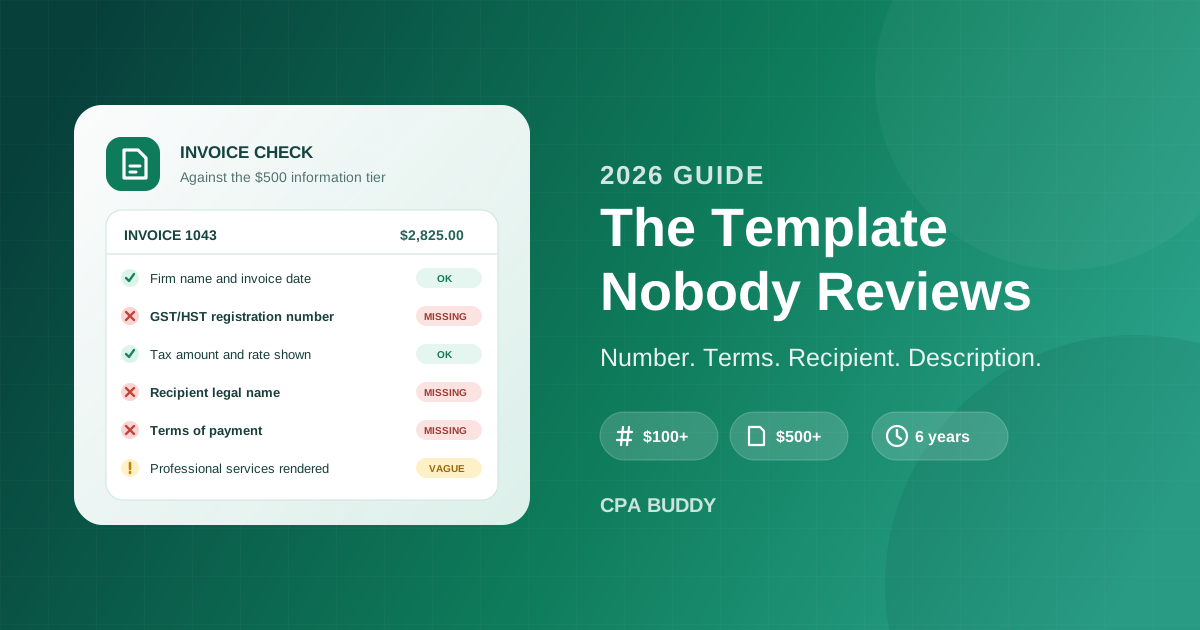
It is called invoice-template-v3.docx and it lives in a folder on somebody’s desktop. It says Professional services rendered, then an amount, then plus GST. It has worked for years. Then a client’s bookkeeper emails asking for your registration number, or a client mentions that the CRA questioned a credit they claimed, and you find yourself reading your own invoice the way you would read a client’s. It is not a good feeling. Every firm reviews its clients’ documentation for a living. The template on the desktop is the one document nobody reviews, and it is doing three jobs at once: billing the client, supporting their claim, and standing as your own record for the next six years.
- Your invoice is your client's supporting documentation. At $500 and above it must carry your registration number, the recipient's name, the terms of payment, and a description that identifies the service.
- A Word file is a document, not a record system. Electronic records have to stay electronically readable for six years, and a folder on a replaced laptop does not clear that bar.
- The failures that cost real money are silent ones: duplicated numbers, a stale tax rate repeated all year, and hours billed twice because nothing marked them as billed.
- The fix is not a better template. It is issuing the invoice from the same place that already holds the client, the engagement, and the time.
Your Invoice Is Your Client’s Supporting Documentation
Subsection 169(4) of the Excise Tax Act and the Input Tax Credit Information (GST/HST) Regulations set out what a registrant must hold before claiming an input tax credit, and the requirement scales with the size of the purchase. Read those tiers as a supplier rather than as an adviser and the picture changes, because you are the one producing the document your client will rely on.
Under $100 including tax
Your name or the name you do business under, the date of the invoice, and the total amount payable.
Rarely an issue at this size, and rarely relevant to professional fees.
$100 to $499.99 including tax
The above, plus your GST/HST registration number and the amount of tax charged, or a statement that tax is included together with the applicable rate.
A registration number that was never added, or one that went stale after the practice reorganized or incorporated.
$500 or more including tax
The above, plus the recipient's name or the name they do business under, the terms of payment, and a description of each supply sufficient to identify it.
Professional services rendered as the only description, no payment terms anywhere on the page, and the invoice addressed to a person rather than to the corporation that is claiming.
Two details deserve emphasis. The thresholds moved on April 20, 2021, up from $30 and $150, so any template or checklist assembled before then is working from superseded numbers. And the recipient name at the top tier means the entity claiming the credit, not the contact whose inbox you send to. An invoice made out to a client’s personal name, where the registrant is their corporation, is the most common version of this failure.
When an invoice is missing prescribed information, the consequence does not land on you. It lands on the client, whose claim can be denied, and who then comes back to their accountant for a corrected document. The CRA does not always insist that every element appear on a single piece of paper, so gaps can sometimes be filled from surrounding records. That is a tolerance, not a design.
A Word File Is a Document, Not a Record
Sales invoices are source documents. Subsection 230(4) of the Income Tax Act requires records to be kept for six years from the end of the last taxation year they relate to, and where a return was never filed for a year, subsection 230(5) runs the same six years from the day that return is eventually filed.
Then there is the provision that catches firms out. Subsection 230(4.1) requires anyone who keeps records electronically to retain them in an electronically readable format for that whole period, even where a paper copy also exists. The CRA reads electronically readable as information supported by a system capable of producing an accessible and usable copy, and its guidance on electronic record keeping is explicit that documents originally created, transmitted, or received electronically must be retained electronically.
A folder of Word files technically satisfies that, right up until you have to use it. The real test is whether you can produce every invoice issued to one client in 2022, in order, matched to the payments received, and tie the set back to your accounting records. Firms discover the answer during a review, a practice inspection, or a fee dispute, which are the three worst times to find out. Keeping billing inside a system with a firm-wide audit trail and role-based access is less about software preference than about being able to answer that question in an afternoon.
The Failures Nobody Notices Until They Matter
None of what follows announces itself. That is the whole problem with it.
Two clients hold invoice 1043
Copy last month's file, change the name and the amount, forget the number. Or skip one and have no explanation for the gap when somebody asks.
A stale rate, all year
Tax typed by hand on each invoice is a rate somebody remembered. One wrong entry repeated for twelve months is a filing correction, not a typo.
The same hours billed twice
A bill retyped from a timesheet leaves nothing marking that time as billed. So it gets billed again, or quietly never gets billed at all.
A receipt written from scratch
The client pays and asks for a receipt. You produce one in Word, unnumbered, matched to the invoice only by whoever typed it.
No proof it was ever sent
Six weeks later the client says the invoice never arrived. Your evidence is a sent-items folder, on a mail account you may no longer have.
Corrections that erase the original
Fixing an issued invoice by editing the file destroys the version the client holds. Nobody can now say what was actually delivered.
The third one connects to money you have already earned. Time that nothing marks as billed is the same leak covered in unbilled time and overdue invoices, and a retyped invoice guarantees it, because the timesheet and the bill never learn about each other.
What a Spreadsheet Adds, and What It Still Misses
Credit where it is due. An Excel register genuinely solves the two worst Word problems. It maintains a number sequence, and it totals what you have issued so you can see the year at a glance. A sole practitioner with a dozen clients, invoicing monthly, running the whole thing personally, is not doing anything wrong with a spreadsheet.
The limits are structural rather than a matter of scale. A register records that an invoice exists. It cannot show that the invoice reached the client, cannot mark the underlying hours as billed, cannot generate a numbered receipt when payment lands, and cannot keep the original when you correct something. The tipping point is not client count. It is the number of people touching the process and the number of documents each client generates in a year, which is exactly the pattern that made deadline spreadsheets stop working for the same firms.
What an Invoicing System Has to Do for a Canadian Firm
Forget features for a moment and write the requirements. An invoice your firm issues should carry your registration number without anyone remembering to add it. Tax should come from a rate and a label configured once, with the ability to mark individual lines as taxable or not and to issue a tax-exempt invoice when that is the right answer. Payment terms belong in a field. The recipient name should come from the client record, so it is the legal entity rather than the contact. The description should come from the engagement, so it identifies the work. Numbering should be sequential without maintenance. Delivery should leave a trace. Payment should produce a receipt in its own sequence. A correction should preserve the original. And six years later, all of it should be retrievable by client and by year.
That list is why timesheets and billing sits inside the same system as clients and engagements rather than beside it. Unbilled time imports into the invoice as line items with hours, descriptions, and rates already filled in, and once issued it is marked billed so it cannot be billed again. A configurable tax rate carries your own label, with per-line taxable toggles and tax-exempt invoices where needed. Payment terms are a setting, whether due on receipt or net 15, 30, or 60. Invoice, refund, and receipt numbering use firm-level prefixes, and payment instructions, default terms, and footer text are configured once and reused. Invoices go out as branded PDFs through a secure link the client opens without a login, settlement is recorded with method, date, and reference, and a sequenced receipt is generated and emailed automatically. When something is genuinely wrong, a refund invoice is raised against the original with quantities validated so refunds cannot exceed it, or the invoice is voided with a required reason and stays in the audit trail rather than vanishing.
Pick a client at random and a year three years back. Can you produce every invoice you issued them, in sequence, with the payments matched and the receipts to prove it, in under ten minutes and without opening a mail client? That is the standard, and it is the one a Word folder fails.
Moving Off the Template Without Losing the Trail
The instinct is to start fresh at number 1. Do not. Your six-year record is a sequence, and breaking it creates exactly the gap you would question on a client file.
Continue the numbering you already have
Pick a cutover date and set the starting number so the new sequence carries on from the last invoice you issued. A prefix change is fine. A restart at 1, with no explanation of the overlap, is not.
Make the old invoices readable and keep them
Export the folder to PDF, store it somewhere the firm controls rather than an individual's device, and keep it for the full retention period. Switching tools does not shorten six years.
Load clients before you load invoices
Get the legal entity names right first, because that is the name the top information tier requires. The contact you email and the registrant who claims the credit are often not the same.
Configure the firm once
Tax rate and label, default payment terms, payment instructions, numbering prefixes, footer text. Every one of these is a field you will otherwise retype on every invoice forever.
Issue the first cycle from the engagement
Import unbilled time rather than retyping a total. This is the step that closes the double-billing gap, because the hours come back marked as billed.
Reconcile once, then retire the template
Compare the first month against what your old register would have produced, confirm the numbering is continuous, then delete the shortcut to the .docx so nobody reaches for it in a hurry.
Where client data already lives in accounting software, bring it across with a controlled import instead of retyping, and validate duplicates before attaching any billing history. The same sequence applies when moving QuickBooks clients into practice management: clean client records first, then the work, then the money.
A Canadian Invoicing Checklist
For every invoice your firm issues, confirm that it shows:
- Your firm name or the name you do business under, and the invoice date.
- Your GST/HST registration number, on anything $100 or more including tax.
- The tax charged, or a clear statement that tax is included and at what rate.
- The recipient’s legal or business name, on anything $500 or more.
- The terms of payment, stated on the invoice rather than agreed verbally.
- A description of the service specific enough to identify it, not just professional services rendered.
- A number that continues an unbroken sequence.
And for the system behind it, confirm that:
- Issued invoices cannot be edited in place, and corrections leave the original intact.
- Payments produce a numbered receipt tied to the invoice.
- Billed time is marked as billed at the moment the invoice is issued.
- Every invoice from the past six years is retrievable by client and by year, electronically.
The template on the desktop is not a small problem, it is a quiet one. It bills correctly most of the time, which is why nobody looks at it, and the two things it is worst at are the two nobody notices until a specific bad day: giving your client documentation that actually supports their claim, and being able to show, years later, exactly what you sent and what you were paid. Start with the ten-minute test. Pick a client, pick a year three years back, and try to produce the full set. CPA Buddy issues invoices from the same record that holds the client, the engagement, and the hours, with your registration number, tax label, terms, and numbering set once at the firm level and a receipt and audit trail attached to every payment.
Frequently Asked Questions
What information must appear on an invoice in Canada?
It depends on the total including tax, under the Input Tax Credit Information (GST/HST) Regulations. Below $100 you need the supplier name or business name, the date, and the total. From $100 to $499.99 you add the supplier's GST/HST registration number and the tax amount, or a statement that tax is included along with the applicable rate. At $500 and above you also need the recipient's name, the terms of payment, and a description of each supply sufficient to identify it. Most accounting firm invoices fall in the top tier.
Do I have to put my GST/HST number on my invoices?
For any invoice of $100 or more including tax, your registration number is part of the prescribed information your client needs to support an input tax credit. Leaving it off does not create a problem for you directly, which is exactly why it goes unnoticed. It creates the problem for the client, whose claim can be denied for missing documentation.
How long does an accounting firm have to keep its sales invoices?
Generally six years from the end of the last tax year the records relate to, under subsection 230(4) of the Income Tax Act. Where a return was not filed for a year, the period runs six years from the day that return is filed. Sales invoices are source documents, so they are covered. If they were created or sent electronically, subsection 230(4.1) requires you to retain them in an electronically readable format for the same period, even when you also hold paper.
Can I keep invoicing clients from a Word template?
Nothing prohibits it, and for a sole practitioner with a handful of clients it can work. The practical limits arrive with volume and with people. A template cannot maintain a number sequence, mark time as billed, prove an invoice was delivered, produce a matching receipt, or preserve the original when you correct something. Those gaps stay invisible until the year you need to reconstruct what a client was actually sent.
What happens if an invoice is missing information the client needs for a credit?
The CRA can deny the claim for insufficient documentation, and the client then has to come back to you for a corrected invoice. The CRA does not always require every element to sit on one piece of paper, so gaps can sometimes be filled from related records. Relying on that is a choice rather than a system, and it is an awkward one for a firm whose job is getting client documentation right.
Related Articles
Ready to streamline your practice?
Join accounting firms across North America using CPA Buddy to transform their practice management.